Foam Production Process - Santech Foam Machines
Product Categories
Foam Machine Accessories

Foam machine accessories by Santech Foam Machines support foam production systems for smooth and efficient machine operation.

Foam Machine Accessories

When Should Foam Manufacturers Upgrade from Batch to Continuous Foaming?

Exploring Foam Variations: What Modern Foam Machines Can Produce

Foam Machine Working Principle: Complete Industrial Guide

Foam is used extensively in mattresses, furniture, automotive, seating, packaging, and more. Behind every produced quality foam is an efficient production system. So, having a basic understanding of the working principle of a foam machine will help your business to improve quality output, reduce waste, and select the right equipment.

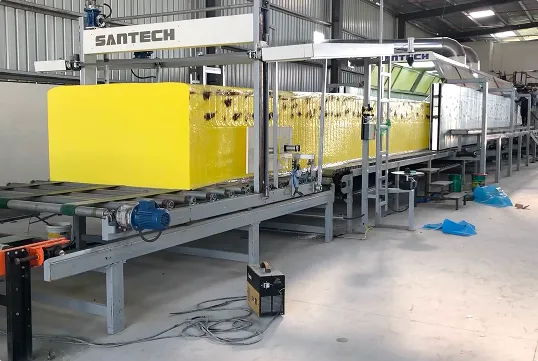
A foam machine mixes chemicals in accurate ratios, thereby creating a controlled reaction and expanding the material into foam blocks or sheets. In fact, modern machines are designed for speed, accuracy, and uniform quality. So, if you are planning to set up a foam production unit, it is important to know how a foam machine works and which system will match your needs. 

ISO vs Non-ISO Foam Manufacturers: What’s the Real Difference?

Whether you are purchasing foam products or planning to set up a production line, the majority of buyers compare the prices first. However, one of the most vital differences that cannot be ignored is certification and quality systems. The debate revolving around the ISO vs. non-ISO foam manufacturers is not limited to paperwork. But it is also about uniformity, safety, efficiency, and long-term value. 

Whether you’re sourcing foam sheets, mattresses, insulation boards, or industrial cushioning, understanding these basic differences will enable you to make informed decisions. Always remember that for any PU foam manufacturer, quality control is the backbone of reliable and stable production. 

Horizontal vs Vertical Foam Cutting Machines: Applications, Uses, and Industrial Benefits

Selecting the right machinery for foam cutting is important for achieving a high level of accuracy and efficiency in foam production. Well, among the various types of foam cutting machines, horizontal and vertical foam cutters are the 2 most widely used. Each of them offers unique features, which make them an ideal choice for different foam fabrication needs.

Foam Shredding Machine: How It Improves Foam Recycling and Waste Management Efficiency

Waste management and recycling are the primary components of the global sustainability efforts, especially when it comes to the industries that produce foam waste.

How Does a Semi-Automatic Batch Foaming Machine Work?

Developing an understanding of how a semi-automatic machine works is important for manufacturers who are involved in foam production. These machines play an important role in producing high-quality polyurethane (PU) foam in controlled batches.

Top 5 Features to Look for in a Foam Cutting Machine in 2026

Choosing the right equipment is vital for maintaining a perfect balance between quality, efficiency, and profitability. Whether your operations include advanced foaming machines or finished foam blocks, the cutting stage plays an important role in determining the final product quality.

Efficient Solutions for Customized Foam Production

Cutomized foam production is gaining significant traction across industries such as furniture, automotive, packaging, bedding, and insulation. Every industry has unique needs for density, durability, flexibility, and shape. To meet these demands, manufacturers often require efficient production systems that will offer accuracy, uniformity, and cost control. In fact, modern technology has made this possible through advanced equipment and manufacturing processes.

From Design to Delivery: Managing a Modern Foam Production Line

The foam manufacturing industry plays an important role in supplying materials for different sectors, including furniture, bedding, automotive, insulation, and packaging. As the expectations of a consumer continue to rise, manufacturers are under a lot of pressure to deliver exceptional-quality products with consistent performance and minimal delays. To achieve this, companies should be able to effortlessly manage everything, that is, from the initial design and material selection to final packaging and delivery.