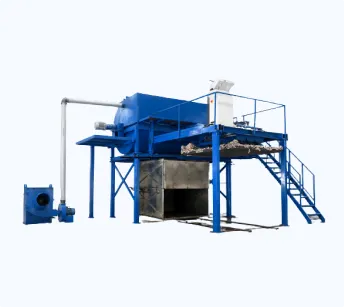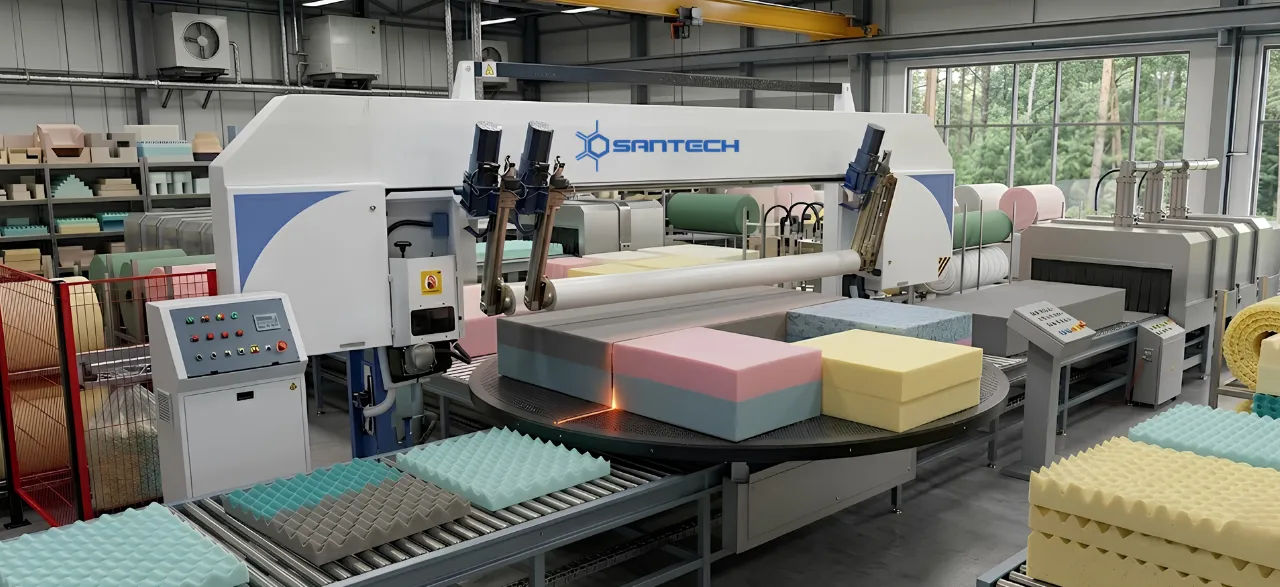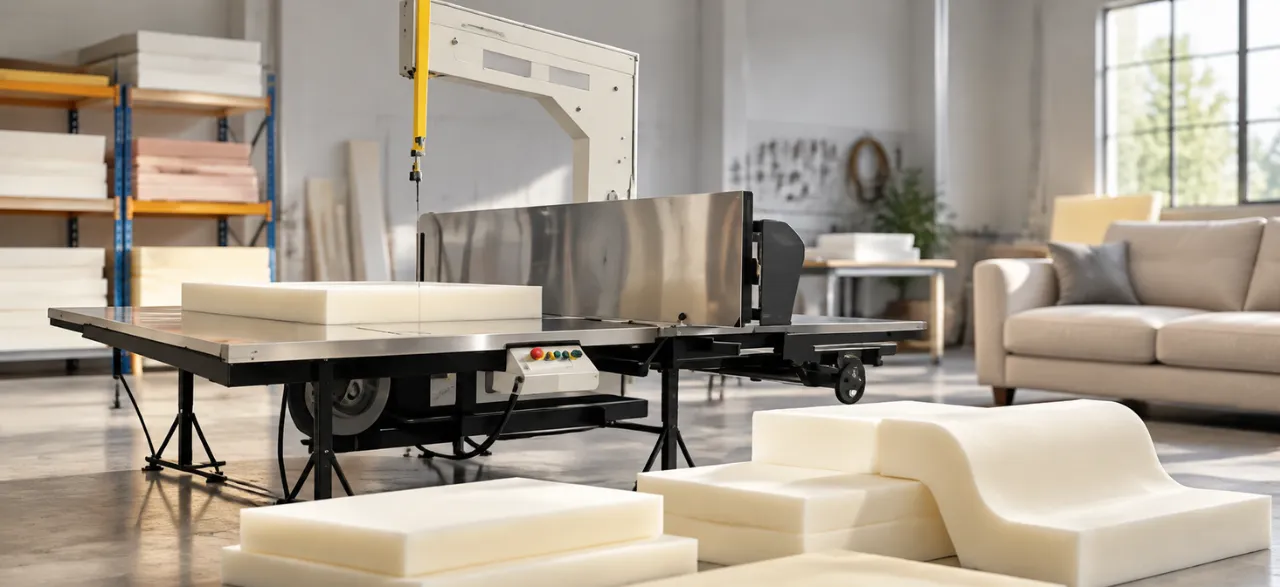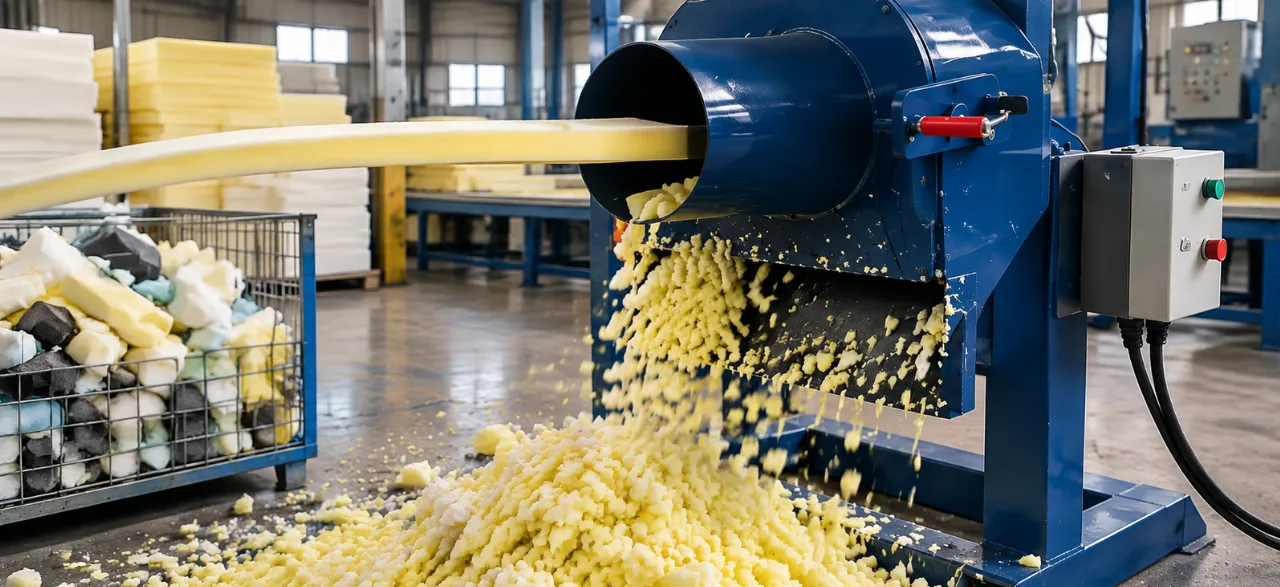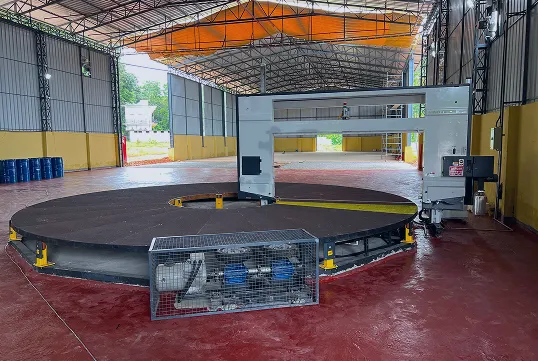
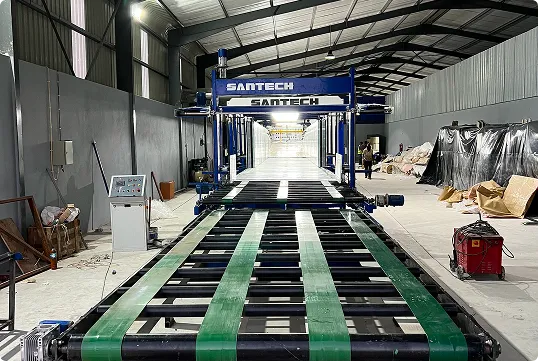
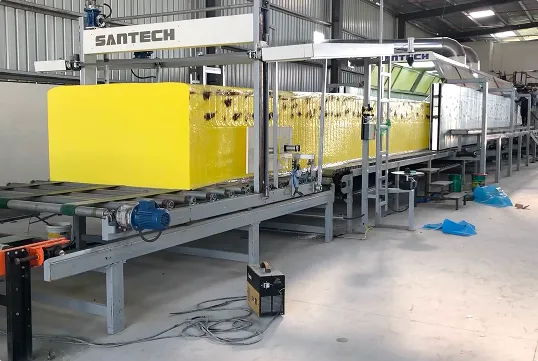
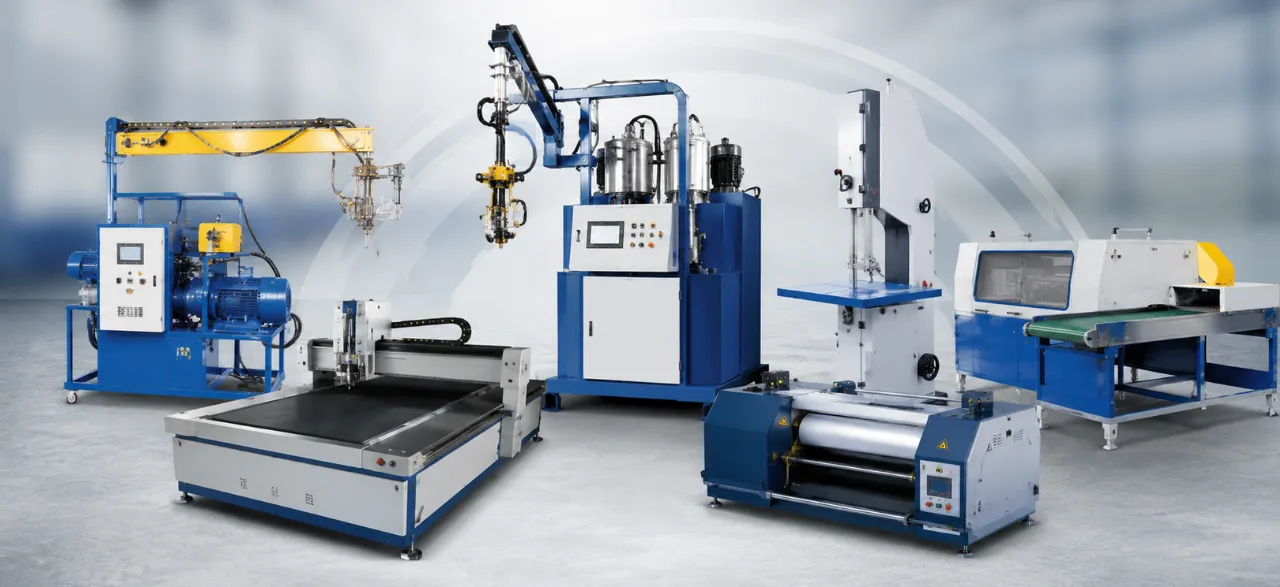


Foam machines are industrial machines used to manufacture, cut, peel, shape, and process foam for products such as mattresses, furniture, cushions, automotive components, packaging, and specialised foam parts. The main types of foam machines include continuous foaming machines, automatic and semi-automatic batch foaming machines, horizontal and vertical foam cutting machines, peeling machines, specialised profile cutters, and foam shredding machines.
Each machine performs a different role in the foam production process. Foaming machines produce PU foam blocks, while cutting and peeling machines convert those blocks into sheets, sections, and customised components. Choosing the right machine depends on your required production capacity, foam specifications, product dimensions, factory space, automation level, and budget.
In this guide, we explain the different types of foam machines, how they work together, where they are used, their key benefits, and what to consider before investing. If you’re planning a new foam manufacturing plant or upgrading your existing setup, this guide can help you identify the right foam machine for your production requirements.
What Are Foaming Machines?
Foaming machines are industrial systems designed to meter, mix, and process chemical components to produce polyurethane (PU) foam with controlled density, hardness, cell structure, and dimensions. Depending on production requirements, manufacturers can use continuous foaming machines or batch foaming machines to produce foam blocks or slabs. For businesses planning to start a PU Foam Manufacturing Business, selecting the right foaming system is an important step in establishing an efficient production setup.
The resulting foam can then be processed using equipment such as horizontal and vertical foam cutting machines, peeling machines, block cut-off machines, and specialised foam cutters to create sheets, blocks, profiles, and components for different applications.
For manufacturers, choosing the right foaming machine depends on factors such as production capacity, foam formulation, required output, automation level, factory space, and budget. Selecting the right system can help improve production consistency, reduce manual work, and support efficient foam manufacturing.
What Are the Different Types of Foam Machines?
The types of foam machines vary according to the stage of foam production and processing. Some machines are used to manufacture PU foam, while others cut, peel, shape, or recycle cured foam blocks. Choosing the right machine depends on production volume, foam specifications, required dimensions, application, and level of automation. The table below covers the main foam machines used across furniture, mattress, packaging, automotive, footwear, and other industries.
| Foam Machine Type | Primary Purpose | Common Uses | Key Benefits |
|---|---|---|---|
| Continuous Foaming Machine | Produces PU foam continuously in long blocks or slabs. | Mattresses, furniture, cushions, packaging, and automotive foam. | High production output, consistent processing, reduced manual intervention, and efficient large-scale production. |
| Automatic Batch Foaming Machine | Produces PU foam in controlled individual batches with automated operations. | Small to medium-scale mattress, furniture, cushion, and foam manufacturing. | Better production consistency, accurate chemical dosing, reduced labour requirements, and flexibility for different foam formulations. |
| Semi-Automatic Batch Foaming Machine | Combines automated foaming operations with selected manual processes. | Small and medium foam manufacturing businesses with varied production needs. | Lower initial investment, operational flexibility, easier production control, and improved consistency compared with manual production. |
| Horizontal Foam Cutting Machine | Cuts foam blocks horizontally into sheets of controlled thickness. | Mattresses, sofas, cushions, upholstery, laminated products, and packaging. | Uniform sheet thickness, accurate cutting, improved productivity, and reduced cutting waste. |
| Vertical Foam Cutting Machine | Cuts foam blocks vertically into required lengths and widths. | Mattress components, furniture cushions, upholstery, packaging inserts, and custom foam parts. | Precise sizing, clean cuts, efficient block processing, and suitability for different foam dimensions. |
| Long Block Peeling Machine | Peels large foam blocks continuously to produce foam sheets or rolls. | Mattress manufacturing, furniture, upholstery, packaging, and laminated foam products. | Continuous sheet production, consistent thickness, higher productivity, and efficient processing of large foam blocks. |
| Round Block Peeling Machine | Processes round or cylindrical foam blocks into continuous sheets. | Specialised foam sheet production and applications requiring processed round blocks. | Consistent peeling, controlled sheet thickness, efficient processing, and reduced manual cutting effort. |
| Block Cut-Off Machine | Cuts large foam blocks into predetermined lengths or sections. | Foam manufacturing plants, mattress production, furniture, and foam processing facilities. | Faster block sizing, consistent dimensions, reduced manual effort, and improved production workflow. |
| Circular Cutting Machine | Cuts foam into circular or curved shapes. | Cushions, furniture, automotive components, specialised foam products, and packaging. | Accurate circular cutting, repeatable shapes, clean edges, and efficient production of specialised components. |
| Variable Angle Cutting Machine | Cuts foam at adjustable angles to create specific profiles and shapes. | Furniture, upholstery, automotive components, specialised cushions, and custom foam products. | Flexible cutting angles, precise profiles, improved design capability, and reduced manual shaping. |
| Pillow Edge Foam Cutting Machine | Produces specialised edge profiles for pillow and cushion components. | Pillow manufacturing, cushions, bedding, and specialised foam products. | Consistent edge shaping, repeatable profiles, improved finishing, and efficient production of shaped foam components. |
| Fast Wire Cutting Machine | Uses a cutting wire to process foam quickly and accurately. | Custom foam components, specialised shapes, packaging, furniture, and industrial applications. | Fast cutting, repeatable results, efficient processing, and suitability for specialised foam shapes. |
| Foam Shredding Machine | Breaks foam scrap and waste into smaller pieces for further processing. | Rebonded foam, cushion filling, recycling, carpet underlay, and waste recovery. | Reduces foam waste, supports recycling, improves material utilisation, and creates usable shredded foam from production scrap. |
The right foam machine is not necessarily the most expensive or automated option. Manufacturers should select equipment according to their production volume, foam type, product dimensions, available factory space, labour requirements, and future expansion plans. In many production facilities, combining different machines—such as a foaming machine, block cut-off machine, peeling machine, and foam cutting machine—can create a more efficient end-to-end foam processing workflow.
How Do Different Foam Machines Work Together?
Different foam machines work together as a complete production and processing system, with each machine handling a specific stage. Continuous or batch foaming machines first produce PU foam blocks, which are then cured before further processing. Block cut-off, peeling, horizontal, and vertical cutting machines convert these blocks into sheets or required sizes, while circular, variable-angle, pillow-edge, and fast wire cutting machines create specialised shapes and profiles. Improving foam cutting accuracy is also important for achieving consistent dimensions and reducing material waste during foam processing. Foam scrap can also be processed using a foam shredding machine for recycling or rebonded foam applications. The right combination depends on production volume, foam specifications, product requirements, and factory setup.
Which Industries Use Foam Machines?
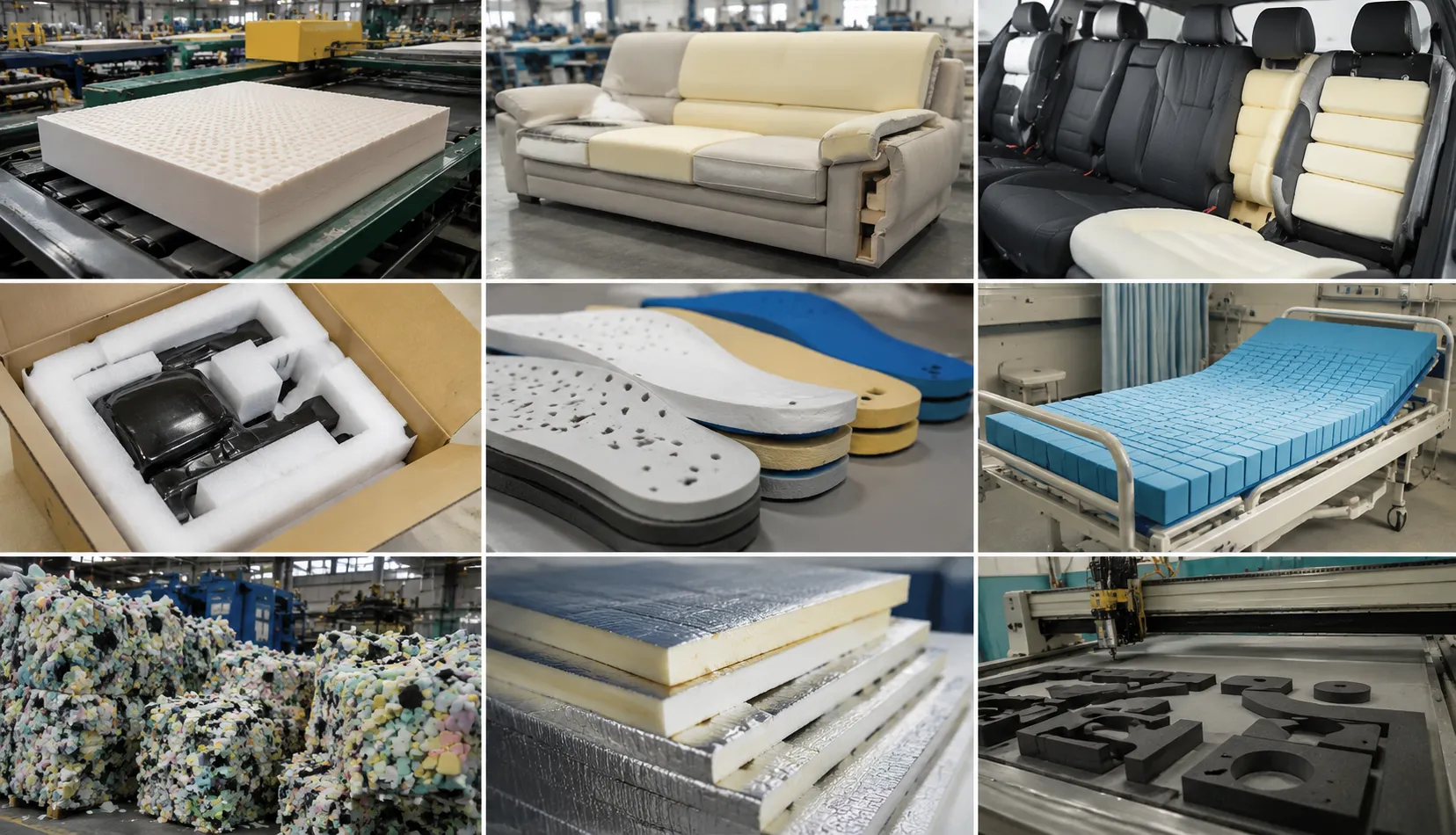
Foam machines are used across a wide range of industries to produce, cut, shape, and process PU foam for different applications:
- Mattress & Bedding Industry – Produces foam blocks, sheets, mattress layers, pillows, and cushioning components.
- Furniture & Upholstery Industry – Used for sofa cushions, chairs, seating, backrests, and customised upholstery foam.
- Automotive Industry – Produces and processes foam for vehicle seats, headrests, armrests, interior components, and cushioning.
- Packaging Industry – Cuts and shapes foam for protective packaging, inserts, cushioning, and customised foam packaging solutions for product protection.
- Footwear Industry – Processes foam for insoles, midsoles, cushioning, and other footwear components.
- Healthcare Industry – Used for medical cushions, support pads, mattresses, and specialised comfort products.
- Rebonded Foam Industry – Foam shredding machines process production scrap into material for rebonded foam products.
- Insulation & Soundproofing – Foam is processed into components used for thermal insulation, acoustic control, and sound reduction.
- Industrial & Custom Foam Applications – Specialised cutting machines create foam profiles, components, and shapes for various manufacturing requirements.
What Foam Machine Is Best for Different Applications?
The best foam machine depends on what you need to manufacture, the type and size of foam you process, your production volume, and the required shape or thickness. A continuous or batch foaming machine is used to produce PU foam, while cutting, peeling, shaping, and shredding machines are used for further foam processing.
| Application / Requirement | Recommended Foam Machine | Why It Is Suitable |
|---|---|---|
| Manufacturing PU foam blocks | Continuous Foaming Machine | Suitable for high-volume production of consistent PU foam blocks or slabs. |
| Flexible batch foam production | Automatic Batch Foaming Machine | Provides controlled batch production with automated operation and accurate chemical dosing. |
| Small to medium-scale foam production | Semi-Automatic Batch Foaming Machine | Combines automated and manual operations while offering production flexibility and lower initial investment. |
| Cutting foam into uniform sheets | Horizontal Foam Cutting Machine | Produces sheets with controlled and consistent thickness for mattresses, furniture, cushions, and upholstery. |
| Cutting foam blocks into sections | Vertical Foam Cutting Machine | Suitable for accurately cutting foam blocks into required lengths, widths, and components. |
| Producing continuous foam sheets | Long Block Peeling Machine | Peels large foam blocks into continuous sheets or rolls for high-volume processing. |
| Processing round foam blocks | Round Block Peeling Machine | Designed to process cylindrical or round foam blocks into continuous sheets. |
| Cutting large blocks to fixed lengths | Block Cut-Off Machine | Helps quickly divide large foam blocks into predetermined lengths with consistent dimensions. |
| Producing circular foam components | Circular Cutting Machine | Designed for accurate circular and curved foam shapes used in cushions, automotive parts, and specialised products. |
| Creating angled foam profiles | Variable Angle Cutting Machine | Allows manufacturers to create specific angled profiles and customised foam shapes. |
| Producing pillow and cushion edges | Pillow Edge Foam Cutting Machine | Creates consistent edge profiles for pillows, cushions, and specialised bedding products. |
| Fast specialised foam cutting | Fast Wire Cutting Machine | Provides quick, repeatable cutting for specialised foam shapes and components. |
| Processing foam scrap and waste | Foam Shredding Machine | Breaks foam scrap into smaller pieces for material recovery, recycling, and rebonded foam applications. |
For example, a mattress manufacturer may require a combination of a foaming machine, block cut-off machine, peeling or horizontal cutting machine, and specialised cutting equipment depending on the final mattress design. A furniture manufacturer may primarily need foam cutting and shaping equipment, while a high-volume PU foam producer may benefit from a continuous foaming system. If you are planning a new facility, understanding the foam manufacturing plant cost can also help you estimate the investment required for machinery, factory space, installation, and production setup.
The right combination of foam manufacturing and foam processing machines can improve production efficiency, cutting accuracy, material utilisation, and product consistency while allowing the manufacturing process to scale with business requirements.
How to Choose the Right Foam Machine: Capacity, Features & Cost
| Foam Machine | Best For | Production / Capacity | Key Features & Benefits | Cost Consideration |
|---|---|---|---|---|
| Continuous Foaming Machine | Large-scale PU foam production | High-volume, continuous production | High output, consistent foam production, automated operation, and efficient chemical dosing. | Higher investment; suitable for businesses targeting large production volumes. |
| Automatic Batch Foaming Machine | Small to medium-scale foam production | Batch-based production | Automated operation, accurate dosing, flexible formulations, and reduced manual work. | Moderate investment; suitable for businesses seeking automation with flexible production. |
| Semi-Automatic Batch Foaming Machine | Small and medium foam manufacturers | Batch-based production | Combines automated and manual operations, flexible production, and easier process control. | Lower initial investment compared with fully automated systems. |
| Horizontal Foam Cutting Machine | Foam sheets for mattresses, sofas, and upholstery | Medium to high processing requirements | Consistent sheet thickness, accurate horizontal cutting, improved productivity, and reduced waste. | Moderate to high investment, depending on configuration and automation. |
| Vertical Foam Cutting Machine | Foam blocks and customised components | Small to large processing requirements | Precise sizing, clean cuts, and flexible foam block processing. | Moderate investment, depending on specifications. |
| Long Block Peeling Machine | Continuous foam sheet or roll production | High-volume block processing | Continuous peeling, consistent thickness, and efficient large-block processing. | Higher investment for industrial-scale production. |
| Round Block Peeling Machine | Processing cylindrical foam blocks | Specialised production | Consistent peeling, controlled sheet thickness, and reduced manual processing. | Specialised investment based on machine configuration. |
| Block Cut-Off Machine | Cutting large foam blocks into sections | Medium to high processing volumes | Faster block sizing, consistent lengths, and reduced manual effort. | Moderate investment depending on capacity and automation. |
| Circular Cutting Machine | Circular and curved foam components | Specialised cutting applications | Accurate circular shapes, repeatable cuts, and clean edges. | Specialised investment based on cutting requirements. |
| Variable Angle Cutting Machine | Angled foam profiles and customised shapes | Custom and specialised production | Adjustable cutting angles, precise profiles, and greater design flexibility. | Moderate to high investment depending on configuration. |
| Pillow Edge Foam Cutting Machine | Pillows and shaped cushions | Specialised component production | Consistent edge profiles, repeatable shaping, and improved finishing. | Specialised investment based on production requirements. |
| Fast Wire Cutting Machine | Custom foam shapes and components | Fast specialised cutting | Quick cutting, repeatable results, and flexible shape processing. | Moderate investment depending on size and specifications. |
| Foam Shredding Machine | Foam scrap recovery and rebonded foam | Continuous or batch scrap processing | Reduces waste, processes foam scrap, and supports material recovery and recycling. | Lower to moderate investment depending on capacity. |
Conclusion
Understanding the types of foam machines helps foam manufacturers choose the right equipment for production, cutting, shaping, peeling, and recycling applications. From continuous and batch foaming machines to horizontal, vertical, circular, peeling, and foam shredding machines, each system serves a specific manufacturing requirement.
The best machine depends on your foam type, production capacity, product dimensions, factory space, automation requirements, and budget. For businesses planning to expand production or set up a new foam manufacturing plant, selecting the right combination of machines can improve productivity, cutting accuracy, material utilisation, and overall production efficiency.
Santech Foam Machines is among the foam machine manufacturers in India offering a comprehensive range of foam manufacturing and processing machines for different industrial requirements. Explore the available machines or contact Santech Foam Machines to find the right solution for your production needs.