

Memory foam is made by combining polyurethane-based chemicals with additives, controlling the chemical reaction and expansion process, curing the resulting foam, and then cutting it into the required shapes and sizes. Each stage needs careful control because the formulation, density, cell structure and curing conditions directly affect the finished foam.
So, how is memory foam made in a manufacturing environment?
The process starts with accurately measured raw materials. These materials are mixed under controlled conditions, allowing the chemical reaction to produce and expand the foam. After expansion, the foam is cured and stabilised before large blocks are cut into sheets, layers or other required shapes.
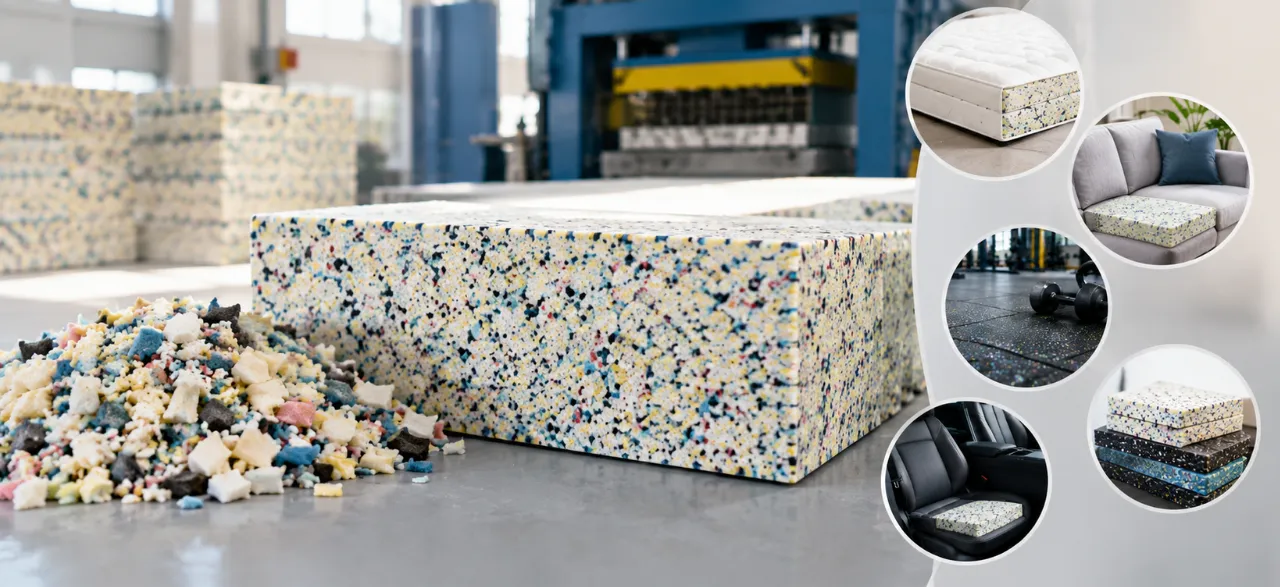
Memory foam is widely used in mattresses, pillows, furniture cushions, automotive seating and medical support products. Understanding how it is manufactured also helps manufacturers determine what type of production and foam cutting equipment they need.
What Is Memory Foam?
Memory foam is a type of polyurethane (PU) foam engineered to have viscoelastic properties. Unlike conventional PU foam, it responds to pressure and temperature and gradually returns to its original shape after the pressure is removed.
This slow recovery and pressure response make memory foam suitable for applications where comfort, support and pressure distribution are important.
Memory foam is commonly used in:
- Mattresses and mattress toppers
- Pillows
- Sofa and furniture cushions
- Automotive seating
- Medical support products
- Specialised cushioning applications
Key Characteristics of Memory Foam
| Property | Benefit |
|---|---|
| Pressure responsiveness | Helps distribute body pressure |
| Slow recovery | Allows the foam to gradually return to its shape |
| Open-cell structure | Supports airflow and comfort |
| Weight distribution | Helps reduce pressure points |
| Flexible structure | Makes it suitable for different applications |
The final properties of memory foam depend on factors such as formulation, density, cell structure and manufacturing conditions.
What Is Memory Foam Made Of?
Memory foam is primarily made from polyurethane-forming chemicals, including polyol and isocyanate, along with catalysts, surfactants, blowing agents and other additives. The formulation and proportion of these materials influence properties such as density, firmness, flexibility and recovery behaviour.
| Material | Purpose in Manufacturing |
|---|---|
| Polyol | Contributes to the flexibility and softness of the foam |
| Isocyanate | Reacts with polyol to form the polyurethane structure |
| Blowing agents | Help create the cellular foam structure |
| Catalysts | Control the speed of chemical reactions |
| Surfactants | Help maintain a consistent cell structure |
| Additives | Can modify properties such as durability, colour, and fire resistance |
The exact formulation can vary according to the required foam specification. Manufacturers therefore need accurate material measurement and controlled processing to achieve consistent results.
How Is Memory Foam Made?
The manufacturing process requires accurate control at every stage. Even small changes in temperature, chemical ratios, and mixing speed can affect the final foam quality. Understanding the foam manufacturing process helps manufacturers maintain consistent foam density, cell structure, and overall product performance.
Step 1: Preparing Raw Materials
The first stage involves preparing and measuring all the required chemicals according to the desired foam specification.
Manufacturers carefully control the following:
- Polyol and isocyanate ratios
- Chemical temperature
- Additive quantities
- Mixing conditions
Precise measurement is important because the wrong formulation can affect foam density, flexibility, and durability.
Modern foam manufacturers often make use of automated dispensing systems to maintain uniformity between production batches.
Step 2: Mixing and Chemical Reaction
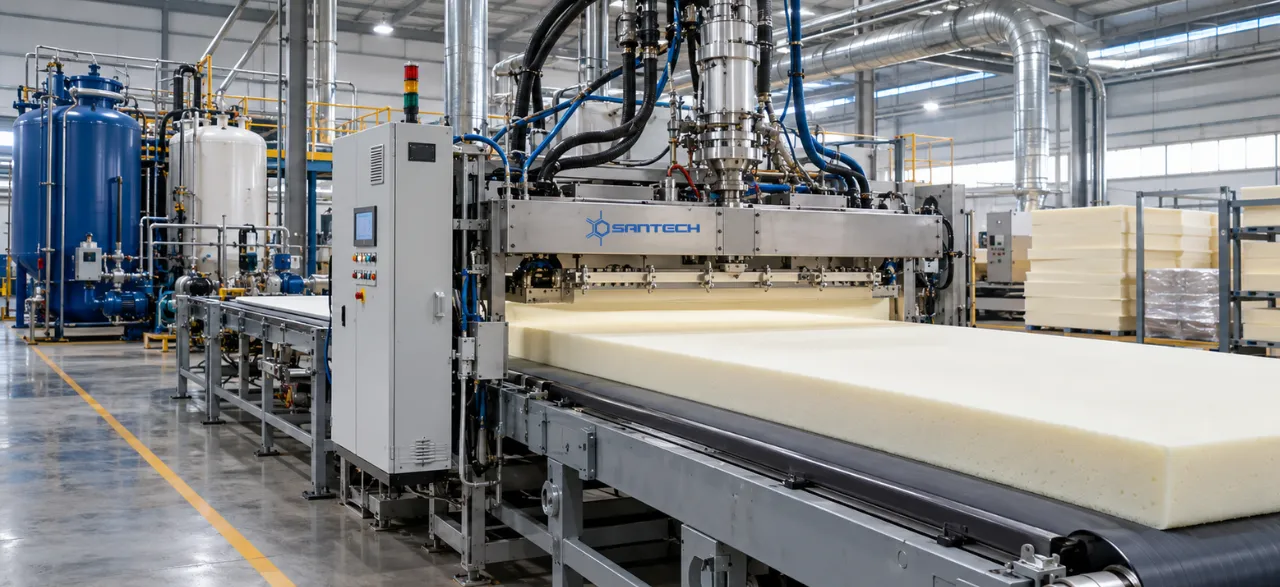
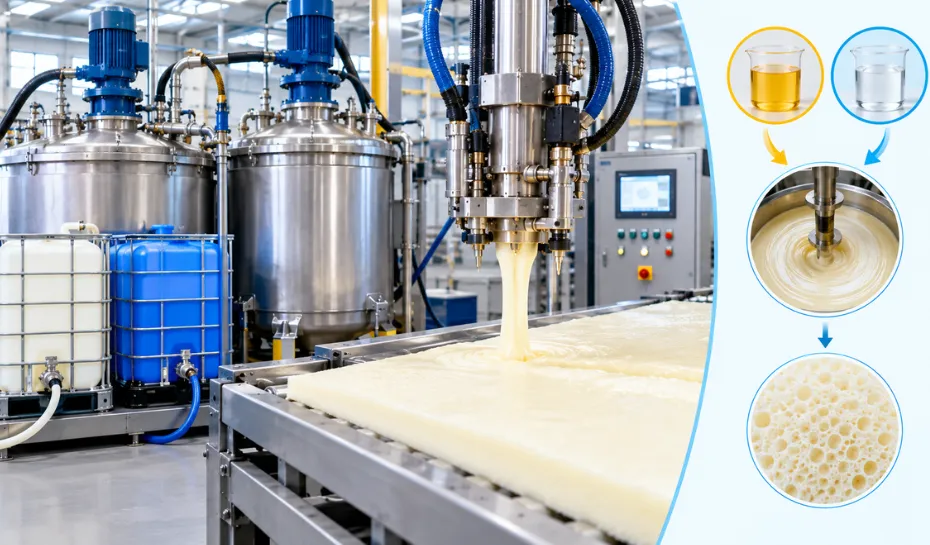
Once the raw materials have been prepared, they are mixed together in specialised mixing equipment.
During this stage, polyol reacts with isocyanate through a chemical reaction known as polymerisation. This reaction creates polyurethane, which forms the base structure of the memory foam.
The mixing process should be controlled carefully due to the following reasons:
- Faster reactions can lead to uneven foam structures.
- Incorrect ratios can reduce durability.
- Poor mixing can create inconsistent density.
Industrial mixing equipment helps distribute the components evenly before the foam begins to expand.
Step 3: Foam Expansion and Cell Formation
After mixing, the chemical blend starts expanding as gases are released during the reaction. This creates millions of tiny cells within the foam structure.
The cell structure directly impacts the following:
| Foam Characteristic | Effect |
|---|---|
| Cell size | Influences airflow and softness |
| Cell consistency | Improves overall performance |
| Density | Determines support and durability |
Manufacturers should carefully assess and monitor the expansion speed and height to achieve the required foam specifications.
This stage is one of the most important parts of understanding the basics of how memory foam is made, as the internal structure determines how the final product feels and performs.
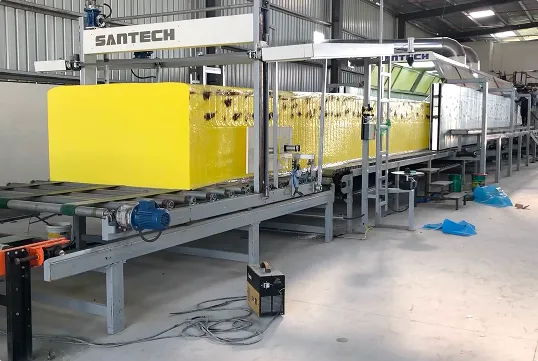
Step 4: Curing the Memory Foam
Once the expansion process has been completed, the foam requires curing to stabilise its chemical structure.
During curing:
- The remaining chemical reactions are completed.
- Internal stress is reduced.
- Foam gains strength and stability.
The curing phase is dependent on a number of factors, including foam thickness, density, and formulation.
Proper curing improves the following:
- Product lifespan
- Shape retention
- Mechanical strength
- Comfort performance
Step 5: Cutting and Shaping Memory Foam
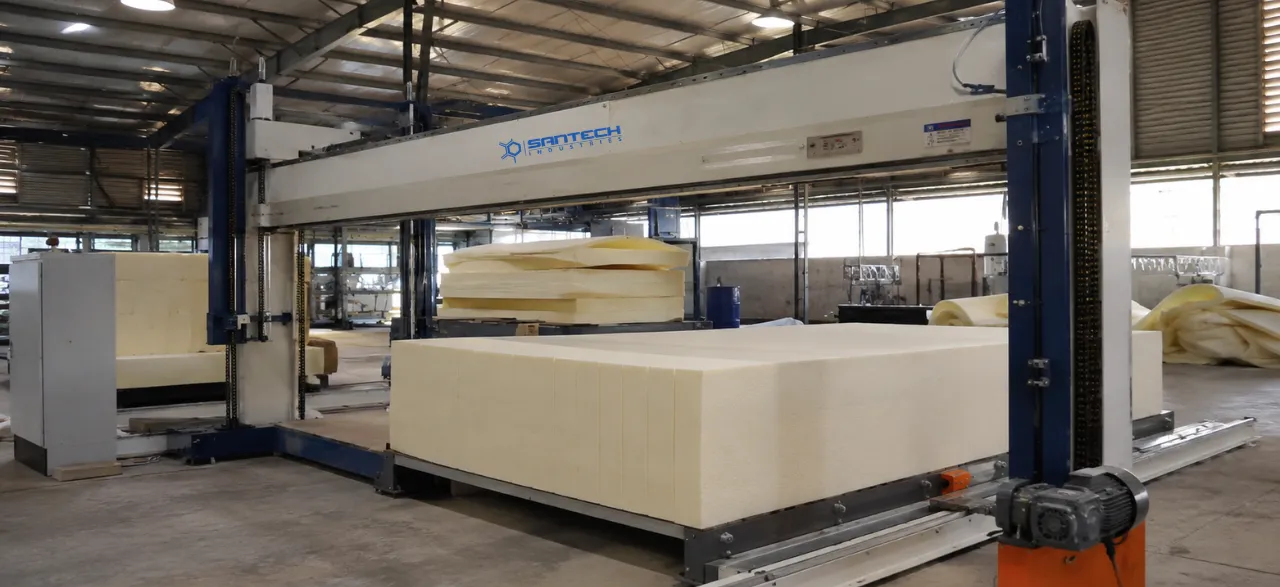
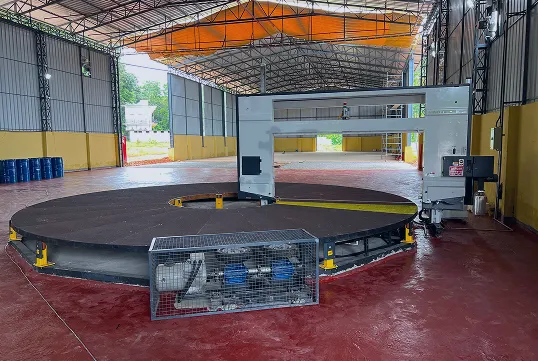
Once cured, large foam blocks are cut into the required shapes and sizes.
Manufacturers use specialised foam cutting machines to create:
- Mattress layers
- Pillow shapes
- Sofa cushions
- Automotive components
- Medical support products
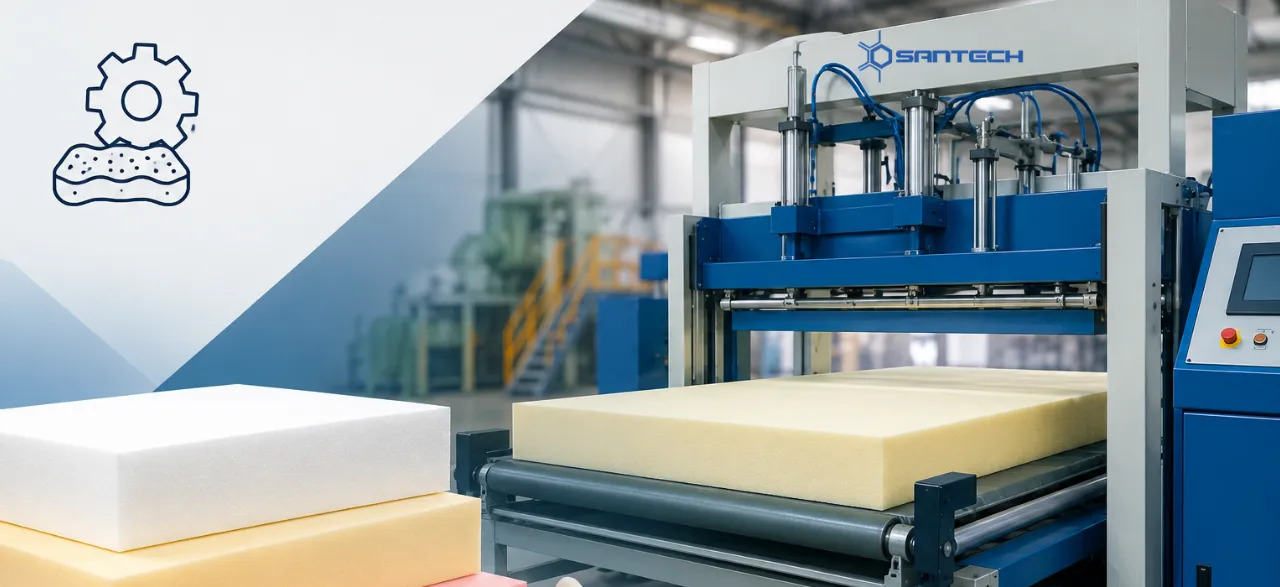
Computer-controlled cutting systems can help achieve precise dimensions while reducing material waste. For manufacturers looking to improve foam cutting accuracy, factors such as machine quality, blade condition, calibration, cutting speed, and foam density should be carefully considered.
What Machines Are Used to Manufacture Memory Foam?
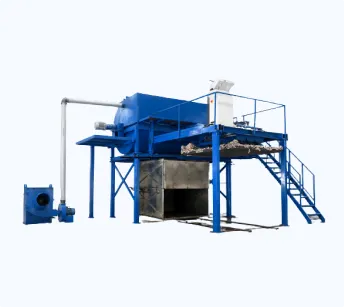
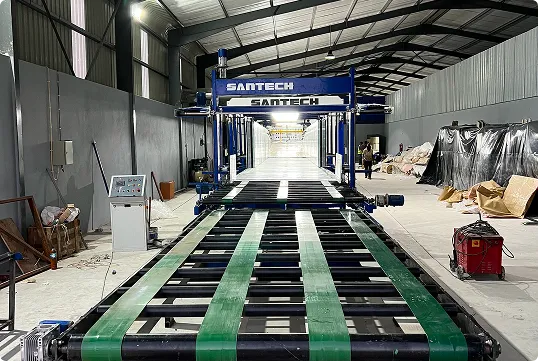
Manufacturing memory foam involves both foam production equipment and foam cutting equipment.
The exact machinery required depends on the production method, formulation, output requirements and finished product.
Common equipment categories include:
| Machine or Equipment | Main Function |
|---|---|
| Mixing equipment | Combines the required raw materials |
| Foaming equipment | Supports controlled foam production and expansion |
| Block cutting machine | Cuts large foam blocks |
| Horizontal foam cutting machine | Produces foam sheets and layers |
| Vertical foam cutting machine | Cuts foam blocks into required dimensions |
| CNC foam cutting equipment | Used for precise shapes where applicable |
For manufacturers, selecting equipment should be based on the actual production requirement rather than choosing a machine solely by its capacity or automation level. Learn more about choosing the right foam manufacturing machine for your production needs.
How to Choose the Right Memory Foam Manufacturing Equipment?
Choosing the right foam manufacturing equipment depends on several factors.
1. Production Capacity
Consider the amount of foam you need to process within a given production period.
Large-volume production may require automated equipment designed for continuous or higher-output operations, while smaller manufacturers may prioritise flexibility and ease of operation.
2. Foam Type and Density
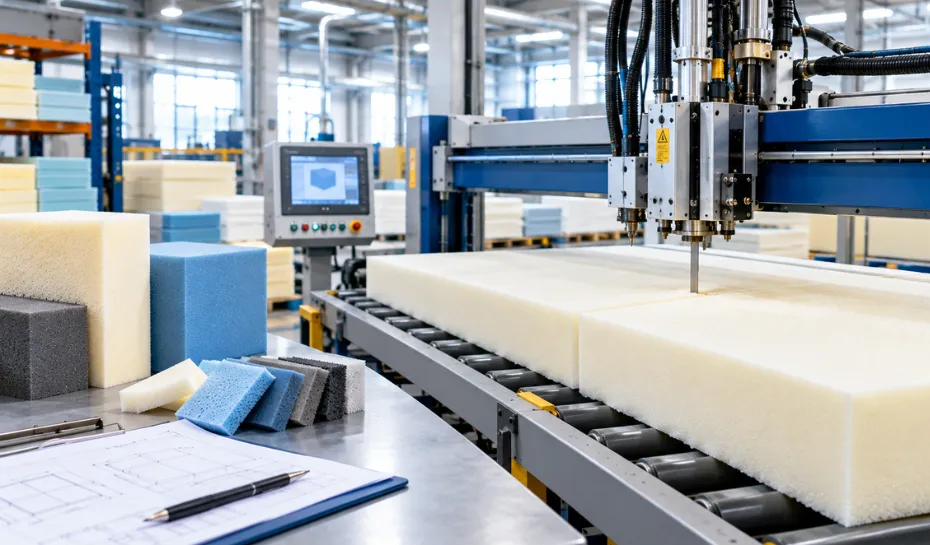
Different foam formulations and densities can require different processing and cutting requirements.
Before selecting equipment, manufacturers should identify:
- Required foam density
- Foam dimensions
- Product specifications
- Expected production volume
- Required cutting formats
3. Cutting Accuracy
The required cutting tolerance is another important consideration.
For mattress layers and other foam components, consistent dimensions can help maintain product quality and reduce material losses.
4. Automation Level
Automation can help reduce manual intervention and improve production consistency.
The appropriate level of automation depends on:
- Production volume
- Labour requirements
- Budget
- Required consistency
- Future expansion plans
5. Machine Flexibility
Manufacturers should also consider whether the equipment can handle their current requirements as well as possible future production needs.
A machine that works for one product format may not necessarily be the best choice if the manufacturer plans to expand into different foam products.
What Factors Affect Memory Foam Quality?
The quality of memory foam is influenced by several factors throughout manufacturing.
| Factor | Impact on Foam Quality |
|---|---|
| Raw material quality | Influences consistency and finished properties |
| Chemical ratio | Affects the characteristics of the resulting foam |
| Foam density | Influences support, weight and durability |
| Cell structure | Affects airflow, feel and performance |
| Curing process | Supports stability and mechanical properties |
| Cutting precision | Helps maintain accurate product dimensions |
It is therefore important to control the complete manufacturing process rather than focusing on only one production stage.
Where Is Memory Foam Used?

Memory foam is used in several industries because of its pressure response, flexibility and cushioning properties.
1. Bedding
Memory foam is commonly used for mattresses, mattress toppers and pillows where pressure distribution and comfort are important.
2. Furniture
Furniture manufacturers use memory foam for selected sofa and seating applications.
3. Automotive
Memory foam and other specialised cushioning materials can be used in automotive seating and headrest applications.
4. Healthcare
Its cushioning and pressure-distribution characteristics make memory foam suitable for certain medical support products and wheelchair cushions.
5. Aerospace
Specialised cushioning applications can also use memory foam and similar viscoelastic materials.
6. Sports
Memory foam can be used in selected support and recovery products.
Memory Foam vs PU Foam: What Is the Difference?
Memory foam and conventional PU foam are both polyurethane-based materials, but they are formulated to perform differently. Memory foam is a specialised type of polyurethane foam designed to respond slowly to pressure and conform more closely to the body. Conventional PU foam generally has a faster recovery and is used where general cushioning, support, or cost-effectiveness is more important.
| Feature | Memory Foam | Conventional PU Foam |
|---|---|---|
| Response | Slow recovery after pressure | Faster recovery |
| Comfort | Conforms closely to the body | Provides general cushioning and support |
| Formulation | Specialised viscoelastic polyurethane formulation | Conventional polyurethane formulation |
| Cost | Generally higher | Generally more economical |
| Applications | Mattresses, pillows, medical products and premium cushioning | Furniture, mattresses, packaging, cushioning and other applications |
The key difference is how the polyurethane foam is formulated and how it responds to pressure. Memory foam is engineered with viscoelastic properties that allow it to gradually compress and recover, creating its characteristic body-contouring feel. Conventional PU foam can be formulated in different densities and firmness levels, but it typically recovers more quickly after pressure is removed.
So, memory foam is not separate from PU foam; it is a specialised type of PU foam. The difference lies mainly in its formulation, structure, density, and resulting performance characteristics.
Why Does Foam Density Matter in Memory Foam?
Foam density is an important factor in determining the performance and quality of memory foam. It can influence the foam’s weight, support, durability, feel, and overall performance.
However, density alone does not determine how memory foam performs. Other manufacturing factors also play an important role, including formulation, cell structure, curing conditions, and consistency. For a better understanding of how density is measured and why it matters in mattress applications, see our guide to foam density in mattresses.
- Chemical formulation: Determines the foam’s basic performance characteristics.
- Cell structure: Influences airflow, softness, and responsiveness.
- Foam thickness: Affects how the material responds to pressure and provides support.
- Curing conditions: Influence the stability and consistency of the finished foam.
- Manufacturing consistency: Helps ensure that each production batch meets the required specifications.
For manufacturers, maintaining consistent foam density from one batch to another is essential when producing memory foam for specific applications. Proper control of the formulation and production process helps achieve more consistent quality and performance.
What Happens After Memory Foam Is Manufactured?
After memory foam has been produced, it needs to undergo curing before it can be processed into the required sizes and shapes. Once the foam block is ready, manufacturers use suitable cutting and shaping equipment to prepare it for the final application.
The typical processing sequence is:
The exact processing steps depend on the product being manufactured. For example, mattress manufacturers may require large foam blocks to be converted into uniform sheets, while pillow and cushion manufacturers may require additional shaping and profile cutting.
Therefore, cutting and shaping equipment should be considered as part of the overall foam manufacturing setup, not as a separate stage after production. Choosing the appropriate equipment can help manufacturers achieve accurate dimensions, consistent products, and efficient material utilisation.
Conclusion
So, how is memory foam made? Memory foam is made by combining polyurethane-based raw materials with carefully controlled additives. The mixture is processed to create the foam structure, followed by expansion, curing, and precision cutting. Factors such as formulation, foam density, cell structure, and processing conditions all influence the quality and performance of the finished foam.
For manufacturers, choosing the right foam manufacturing machine and foam cutting equipment is important for maintaining consistent production, foam quality, and accurate product dimensions. The equipment should be selected according to production capacity, foam specifications, and the required cutting process.
Santech Foam Machines is a trusted foam machine manufacturer in India, providing foam manufacturing and cutting solutions for different production requirements.
If you are planning a foam manufacturing setup or looking for the right foam manufacturing machine, explore Santech Foam Machines’ equipment range or contact the team to discuss your production requirements.