

Foam is used extensively in mattresses, furniture, automotive, seating, packaging, and more. Behind every produced quality foam is an efficient production system. So, having a basic understanding of the working principle of a foam machine will help your business to improve quality output, reduce waste, and select the right equipment.
A foam machine mixes chemicals in accurate ratios, thereby creating a controlled reaction and expanding the material into foam blocks or sheets. In fact, modern machines are designed for speed, accuracy, and uniform quality. So, if you are planning to set up a foam production unit, it is important to know how a foam machine works and which system will match your needs.
What is a Foam Machine?
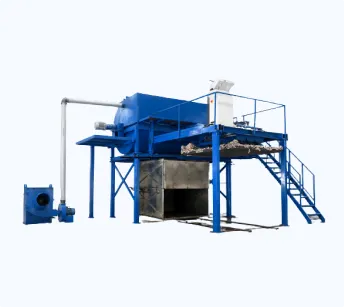
A foam machine is an industrial equipment that is used for producing foam by seamlessly combining different raw materials such as polyols, isocyanates, catalysts, water, and adhesives. These materials react chemically and expand into foam.
Depending on the capacity of production, foam machines are commonly available as
- Continuous foaming machines
- Batch foaming machines
- Semi-automatic foam machines
- Fully-automatic foam machines
Each machine is used to deliver stable foam density, shape, and cell structure for different industrial uses.
Comprehensive Guide on the Working Principle of a Foam Machine
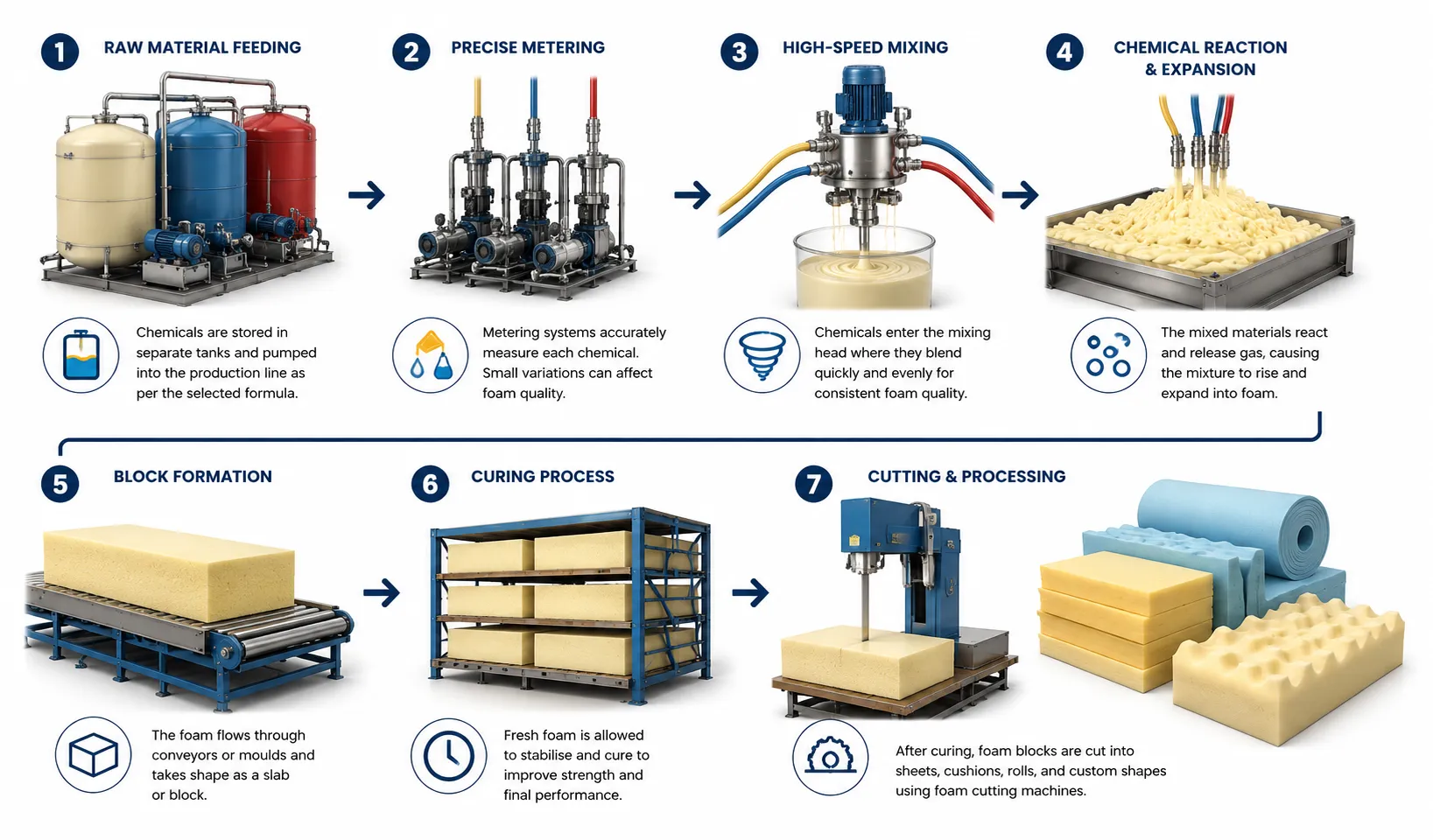
The working of a foam machine is based on precise metering, mixing, chemical reaction, expansion, and curing. It is important to ensure that every stage is controlled carefully for a stable production.
Raw Material Feeding
The machine starts working by storing the chemicals in different tanks. Then the pump feeds in the required material into the production line as per the chosen formula.
Precise Metering
Metering systems are responsible for measuring each chemical accurately. Even small variations can affect foam density, hardness, or recovery.
High-Speed Mixing
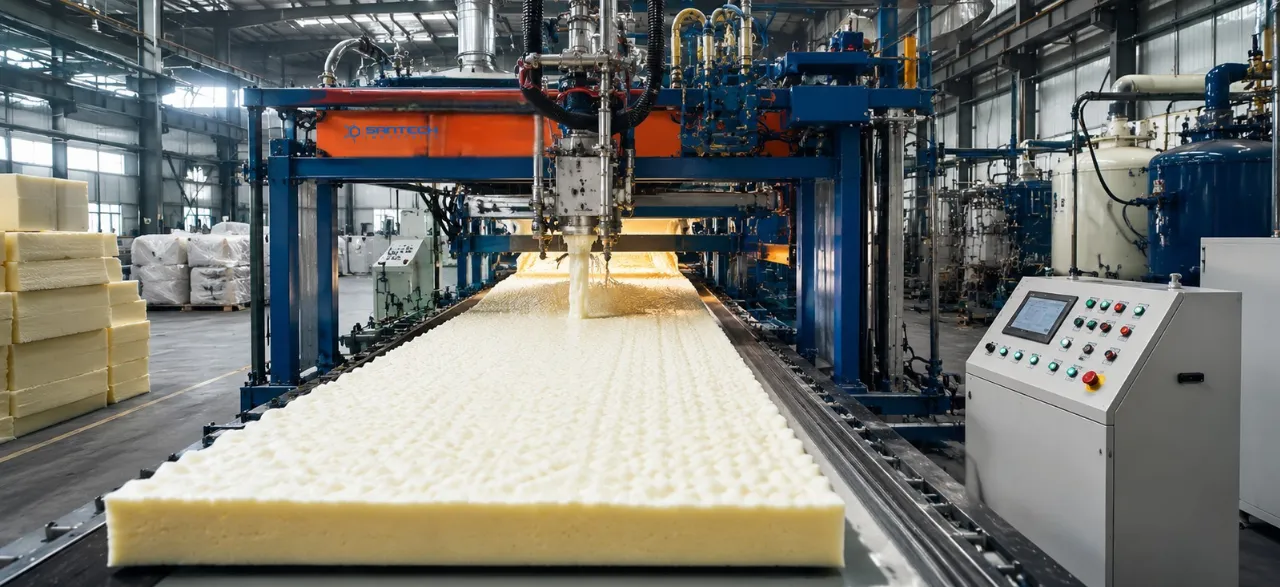
As a next step, chemicals enter the mixing head, where they blend quickly and evenly. Good mixing is important for consistent foam quality.
Chemical Reaction and Expansion
Once mixed, the materials react and release gas. This causes the mixture to rise and expand into foam.
Block Formation
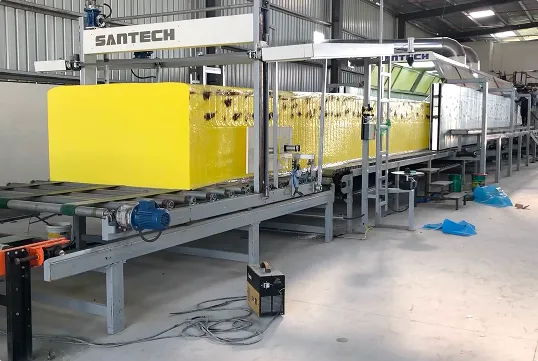
The foam then makes its way through the conveyors or moulds, where it turns into a slab or a block.
Curing Process
Fresh foam requires time to stabilise and cure. This helps in improving strength and final performance.
Cutting and Processing
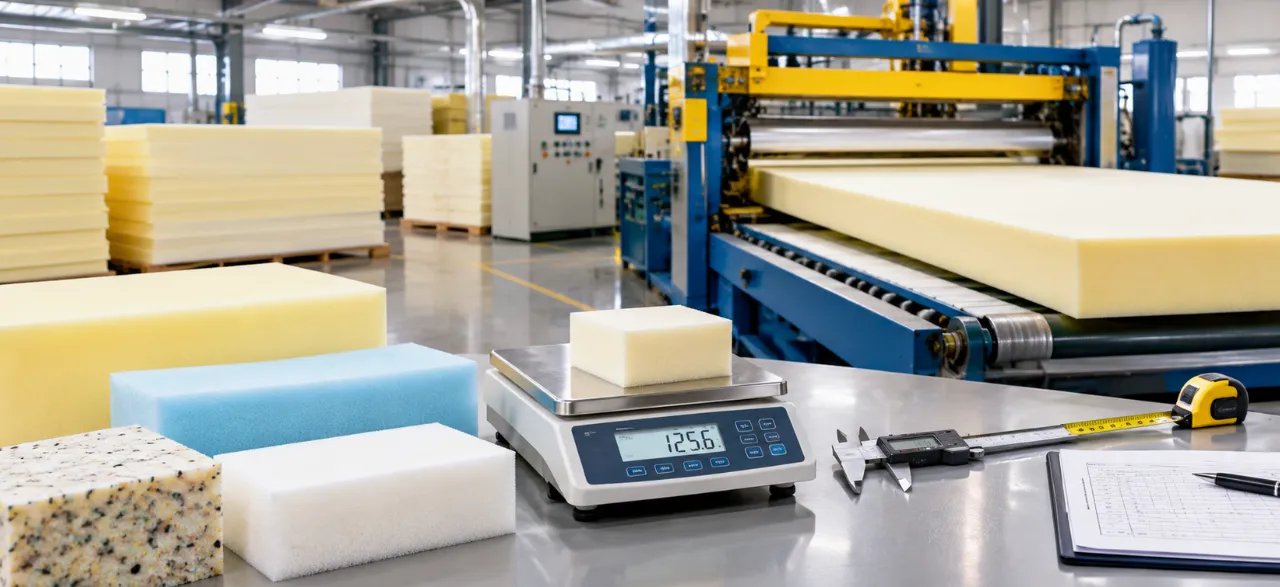
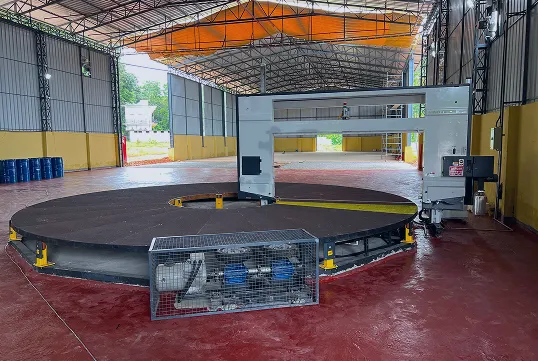
After curing, foam blocks are cut into sheets, cushions, rolls, and custom shapes using foam cutting machines.
How Do Foam Machines Work in Continuous Production
If you want to know about how foam machines work in high-volume factories, continuous systems are the preferred choice.
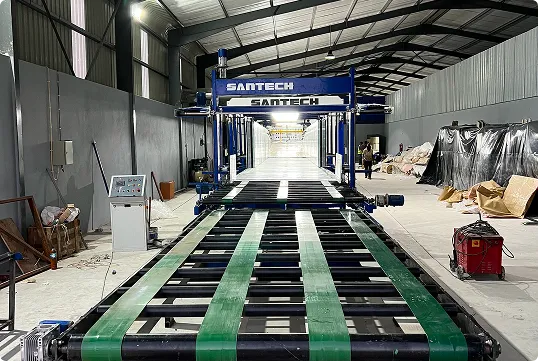
Continuous machines operate by producing foam slabs without interruption. Raw materials are mixed continuously, and the foam that is supposed to be expanded travels on conveyors. This method provides:
- High production speed
- Uniform foam blocks
- Lower material waste
- Better uniformity
- Cost-efficient long runs
These machines are an ideal choice for mattress and furniture production.
Working Process of a PU Foam Machine
PU foam is popular since it is durable, flexible, lightweight, and comfortable. Important steps involved in the working of a PU foam machine are
- First and foremost, polyol and isocyanate are pumped into the system.
- Additives help in controlling softness, density, and reaction speed.
- As the process moves ahead, mixing helps in creating a fast chemical reaction.
- Foam rises and forms open or closed cells.
- Lastly, material cures into usable foam blocks.
PU foam machines are commonly used for:
- Mattresses
- Sofa cushions
- Car seats
- Acoustic foam
- Packaging products
Since the quality of the product is dependent on precise dosing, advanced PU machines use PLC controls and touchscreen systems for efficient precision.
Types of Foam Machines for Industry
- Continuous Foaming Machine: They are best suited for large-scale production where the output volume is high.
- Batch Foaming Machine: They are an ideal choice for smaller production runs or special foam grades.
- Semi-Automatic Foaming Machine: They offer a good balance between manual control and automation.
- Fully Automatic Machine: It will be a perfect choice for modern plants requiring maximum productivity and repeatable results.
Therefore, choosing the right machinery depends on your overall production targets, availability of labour, factory space, and budget.
Why Machine Quality Matters
A reliable foam machine offers several benefits, including:
- Better foam consistency
- Lower chemical waste
- Reduced downtime
- Faster and more efficient production cycles
- Easier maintenance
- Improved operator safety
Poor-quality machinery often leads to uneven foam quality, production delays, and higher operating expenses.
How to Choose the Best Foam Machine Manufacturers in India
When selecting the best foam machine manufacturers in India, you are supposed to focus on more than just price. A strong supplier should be able to offer engineering support, installation guidance, spare parts, and after-sales service.
Look for manufacturers providing:
- Proven industrial experience
- Custom machine solutions
- Modern automation systems
- Strong service support
- Durable machine construction
- Competitive operating efficiency
Reputed foam machine manufacturers in India will help businesses by scaling production while also maintaining quality standards.
Wrapping Up
Understanding the basic working principle of a foam machine is important for anyone entering foam production. Whether you require batch systems or high-speed continuous lines, knowing how a foam machine works will help you choose the right setup.
Modern PU machines help in streamlining the process with accurate controls, efficient mixing, and uniform results. Teaming up with experienced foam machine manufacturers in India will help the businesses boost productivity and produce high-quality products.