
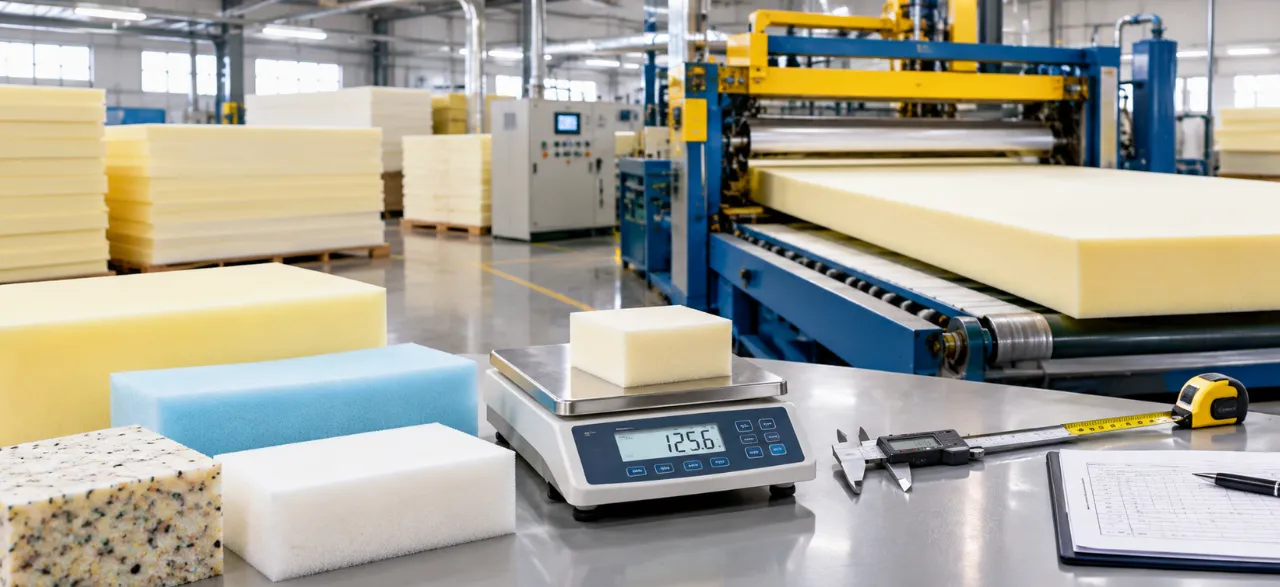


PU foam density measures the mass of polyurethane foam per unit volume and is commonly expressed in kilograms per cubic metre (kg/m³). To calculate it, divide the mass of a representative foam sample by its volume. Accurate measurement helps manufacturers check foam consistency, compare material grades, and identify variations during production.
However, higher density does not automatically mean greater firmness or better quality. Foam performance also depends on its formulation, firmness, resilience, and intended application. Manufacturers must therefore evaluate density alongside other relevant material properties.
This guide explains how to calculate PU foam density with a practical example, measure foam accurately, understand typical flexible foam density ranges, and control density variations during manufacturing. It also covers common measurement mistakes and quality-control practices to help manufacturers make informed production decisions when selecting a PU foam machine and planning consistent foam production.
What Does PU Foam Density Mean?
PU foam density is the mass of polyurethane foam contained within a specific volume. It includes the foam’s cellular structure, so the measurement represents the overall mass of the sample rather than the weight of the solid polymer alone. Understanding how foam is made helps explain how raw materials form a cellular structure that influences foam properties.
Density is commonly expressed in kilograms per cubic metre (kg/m³). Some technical documents use pounds per cubic foot (lb/ft³ or pcf).
For example, a foam with a density of 40 kg/m³ has a mass of 40 kilograms per cubic metre. A smaller sample of the same material should produce a similar density result when measured accurately and sampled representatively.
Manufacturers use polyurethane density as one specification for comparing foam grades and checking production consistency. However, density should be evaluated alongside firmness, resilience, compression performance, and other properties relevant to the product.
The Polyurethane Foam Association provides technical information about flexible polyurethane foam properties and explains why density and firmness must be treated as different characteristics.
How to Calculate Foam Density
The formula for calculating foam density requires two measurements: mass and volume.
When mass is measured in kilograms and volume in cubic metres, the result is expressed in kg/m³.
For a rectangular sample, calculate volume by multiplying its length, width, and thickness. Measure all dimensions in the same unit and avoid compressing the foam while taking measurements.
Worked Example of Foam Density Calculation
Consider a rectangular polyurethane foam sample with the following measurements:
| Measurement | Value |
|---|---|
| Length | 20 cm |
| Width | 20 cm |
| Thickness | 5 cm |
| Volume | 2,000 cm³ |
| Volume in cubic metres | 0.002 m³ |
| Sample mass | 80 g (0.08 kg) |
Step 1: Calculate the volume
Convert the volume into cubic metres:
2,000 ÷ 1,000,000 = 0.002 m³
Step 2: Convert the sample mass
Step 3: Calculate the density
Therefore, the sample has a calculated density of 40 kg/m³.
You can also calculate density directly when mass is measured in grams and volume in cubic centimetres:
Using the same example:
The key to an accurate calculation is consistent units, reliable measurements, and a representative foam sample.
How Is Foam Density Measured Accurately?
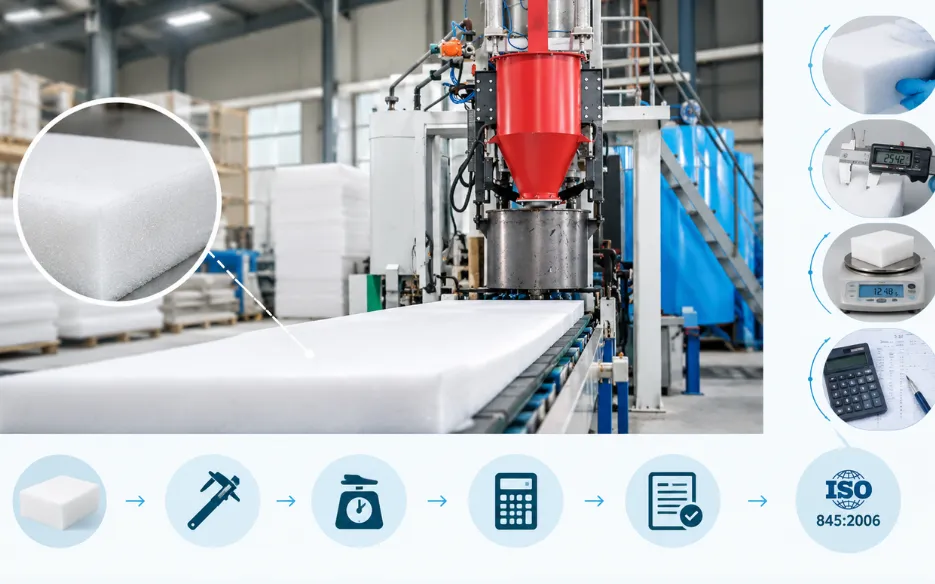
Accurate foam density measurement depends on the sample selected, the measurement method, and the testing procedure. A simple mass-to-volume calculation is useful for preliminary checks, while formal quality testing should follow the applicable standard and agreed product specification.
Follow these steps for a basic dimensional measurement:
- Select a representative sample: Choose a sample from the relevant foam batch and document its location.
- Prepare the sample: Use a suitable, regular shape where possible. Avoid unnecessary compression or deformation.
- Measure the dimensions: Record length, width, and thickness using suitable measuring equipment.
- Measure the mass: Use an appropriate weighing scale and record the sample’s mass.
- Calculate the volume: Multiply the dimensions and convert the result into cubic metres if necessary.
- Calculate the density: Divide mass in kilograms by volume in cubic metres.
- Record and compare the result: Document the result, sample location, batch identification, and testing conditions.
For production quality control, use a consistent sampling plan and repeat measurements when results appear unusual.
Surface skin can also influence apparent density. A sample containing the surface layer may produce a different result from a sample taken from the foam core. The appropriate sampling method depends on whether the objective is to measure overall density, core density, or another specified property.
ISO 845:2006 addresses the determination of apparent density in cellular plastics and rubbers. Manufacturers conducting formal testing should consult the applicable standard, verify the relevant edition, and follow the required sampling and conditioning procedures.
What Is the Typical PU Foam Density Range?
There is no single PU foam density range suitable for every application. Flexible cushioning foam, viscoelastic foam, rigid insulation foam, and other polyurethane materials serve different purposes and should not automatically be compared using the same density criteria.
Covestro’s technical information describes flexible foam blocks used in mattresses and upholstered furniture across a broad range of densities. Selected flexible foam formulations reported in industry studies also illustrate how density can vary between foam categories.
The following figures are examples from an industry study, not universal manufacturing specifications
| Example of flexible PU foam | Density reported in the study |
|---|---|
| Lower-density conventional foam | 18–25 kg/m³ |
| Higher-density conventional foam | 35–40 kg/m³ |
| Viscoelastic foam | 45–53 kg/m³ |
These values should be interpreted in the context of the formulation, product design, testing method, and intended use.
When selecting a target density, manufacturers should consider the customer’s specification, the application, and the other physical properties required. A density figure alone cannot establish whether a particular foam is suitable for a mattress, sofa cushion, packaging component, or insulation product.
Does High-Density PU Foam Mean Greater Firmness?
No. High-density PU foam contains more mass per unit volume than lower-density foam, whereas firmness describes the resistance of a material to compression under specified test conditions.
Foams can have similar densities but different firmness levels. Conversely, foams with different densities may have similar firmness. Formulation, polymer structure, additives, and manufacturing conditions can influence the resulting properties.
This distinction matters when manufacturers select materials for mattresses, upholstered furniture, automotive seating, and other cushioning applications.
Density and firmness are different properties, so comparing foam grades requires understanding their characteristics and intended applications. Explore our guide to the differences between high-density foam and memory foam for a more detailed comparison.
How Can Manufacturers Control PU Foam Density?

Manufacturers can control PU foam density by maintaining consistent raw-material ratios, monitoring processing conditions, and following standardized quality-control procedures. Accurate dosing, consistent mixing, and appropriate curing help reduce density variations between production batches.
Before establishing a production facility, manufacturers should also evaluate equipment requirements, plant space, and investment costs. This guide to the cost of setting up a foam manufacturing plant explains key factors that influence the overall investment and production setup.
To maintain consistent PU foam density, manufacturers should:
-
Control raw materials: Follow the approved formulation and verify ingredient quantities.
-
Monitor production conditions: Keep temperature, mixing, and processing parameters within established operating limits.
-
Standardize testing: Use consistent sample dimensions, weighing methods, and density calculations.
-
Maintain quality records: Record density results for each batch and compare them against the required specifications.
-
Investigate variations: Check material dosing, equipment conditions, and measurement methods when results fall outside acceptable limits.
Regular testing and documented process controls help manufacturers identify inconsistencies and maintain foam quality. Density should also be evaluated alongside firmness and other relevant physical properties to ensure the foam meets its intended application requirements.
1. Maintain Consistent Raw-Material Dosing
Follow the approved formulation and verify that raw materials are dispensed in the specified quantities. Investigate dosing discrepancies before making process changes.
2. Monitor Production Conditions
Maintain process parameters within established operating limits. Temperature, mixing conditions, and material consistency can influence foam formation and should be monitored according to the production procedure.
3. Allow Appropriate Curing and Stabilization
Follow the manufacturer’s process requirements before testing the foam. Testing at inconsistent stages can complicate comparisons between batches.
4. Standardize Sampling
Use a defined sampling plan, consistent sample dimensions, and repeatable measurement methods. This makes it easier to distinguish genuine production variations from measurement errors.
5. Maintain Quality Records
Record the measured density, production batch, sample location, date, and relevant process conditions. Compare results against the product specification and permitted tolerance.
6. Investigate Persistent Deviations
If repeated measurements fall outside the accepted range, investigate the formulation, raw-material records, equipment conditions, sampling method, and measurement accuracy. Make adjustments only through the established manufacturing and quality-control procedure.
Common Mistakes When Measuring Foam Density
Even a correct formula can produce a misleading result if the sample or measurement method is unsuitable.
| Common mistake | Why it causes problems |
|---|---|
| Weighing an entire mattress | The weight may include fabric, springs, adhesives, and multiple foam layers. |
| Compressing the foam during measurement | Reduced measured dimensions can produce an incorrect volume. |
| Using irregular offcuts | Uneven shapes make volume calculations less reliable. |
| Comparing surface-skinned and core samples | The samples may have different apparent densities. |
| Mixing measurement units | Inconsistent units lead to calculation errors. |
| Treating density as a firmness measurement | Density and firmness represent different material properties. |
| Testing inconsistent sample locations | Variations in sampling can make batch comparisons misleading. |
When a result appears unusual, verify the dimensions, units, scale, sample location, and testing procedure before concluding that the manufacturing process has changed.
Conclusion
PU foam density is calculated by dividing a foam sample’s mass by its volume, helping manufacturers assess material consistency and maintain production quality. Accurate measurements, standardized testing, and regular quality checks are essential for identifying density variations and ensuring that foam meets the required specifications. However, density should always be evaluated alongside firmness and other relevant physical properties.
With over 28 years of industry experience, Santech Foam Machines supports foam manufacturers with equipment for foam production and processing. Choosing the right foam making machine and maintaining consistent production practices can help manufacturers improve process control and achieve more reliable foam quality.