Which Foam Machine Is Best for High-Volume Production?
Product Categories
Foam Machine Accessories

Foam machine accessories by Santech Foam Machines support foam production systems for smooth and efficient machine operation.

Foam Machine Accessories

Which Foam Machine Is Best for High-Volume Production?

Which Foam Machine Is Best for High-Volume Production

High volume foam production demands speed, uniformity, and the right machinery. A foam production machine is not only used for making foam blocks, but it also helps in deciding how smoothly the production will run, how consistent the foam quality remains, and how efficiently the raw materials are used. 

For businesses that are responsible for producing foam for mattresses, furniture, automotive seating, packaging, insulation, and industrial use, selecting the right machine is an important decision. In fact, the best option will largely depend on production capacity, foam type, total available space, automation level, and long-term business goals. 

What is the Importance of Choosing the Right Foam Production Machine?

A high-volume setup cannot solely rely on slow or inconsistent output. When the demand rises, manufacturers will require a machine that can easily produce foam continuously without affecting the quality. 

A suitable foam production machine can help manufacturers by: 

  • Producing larger foam blocks or slabs 
  • Maintaining uniform density and quality 
  • Reducing manual handling 
  • Improving production speed 
  • Support different foam formulations 
  • Minimising wastage during processing 

This is the major reason that high-volume manufacturers often move from basic batch systems to more advanced continuous systems. 

Understanding Different Types of Foam Machines

Well, before choosing the best machine, it is important to understand the different types of foam machines that are used widely in the industry.

Manufacturing Stage Process Description Purpose
Raw Material Preparation Polyol, isocyanate, catalysts, water, silicone, and additives are accurately measured and prepared. Ensures consistent foam quality and desired physical properties.
Foam Generation Raw materials are mixed in a PU foaming machine, causing a chemical reaction that expands into a foam block. Creates the polyurethane foam structure.
Foam Curing The foam block is allowed to cure until it reaches dimensional stability and full strength. Improves durability and structural integrity.
Sheet Cutting Horizontal foam cutting machines slice the cured block into sheets of precise thickness. Produces uniform foam sheets for various applications.
Rolling & Inspection Foam sheets are rolled, inspected for density, thickness, and quality before packaging. Ensures product consistency and readiness for shipment.
End Applications Finished foam sheet rolls are supplied to mattress and furniture manufacturers. Used for mattresses, sofas, chairs, headboards, and other upholstered products.

Why Continuous Foaming is Considered Best for High-Volume Production

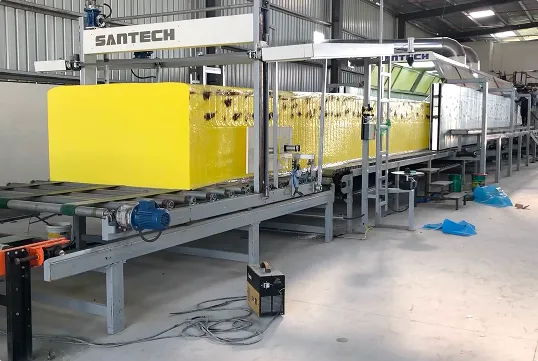
For large-scale manufacturing, a continuous foaming machine is generally the most practical and efficient choice, as it is designed to produce long slabs of foam without stopping after every batch. 

This makes them a suitable choice for factories that require regular production of foam for mattresses, upholstery, furniture, packaging, automotive use, and industrial applications. 

Well, a continuous system offers several benefits, including the following: 

Higher Output

The machine can produce foam continuously, which makes it a perfect choice for bulk manufacturing. 

Better Uniformity

The machine helps in controlling chemical flow, conveyor movement, and foam rise more precisely. 

Less Manual  Work

There are a majority of modern systems that consist of automated controls, which further help in reducing dependency on manual adjustments. 

Improved Efficiency

Continuous production helps in saving time and offers support for a smoother workflow across the factory. 

Different Foam Types Produced by High-Volume Machines

Understanding the Basics of the Foam Production Process


High-volume foam machines can easily produce different types of foam depending on the formulation and the capability of the machine.

Common Applications of Foam Sheet Rolls

The most common applications of foam sheet rolls include:

  • Mattress support layers
  • Comfort layers for mattresses
  • Memory foam mattress components
  • Edge support structures
  • Sofa cushions
  • Chair padding
  • Headboards
  • Armrests
  • Seating systems

Among all the mentioned examples, PU foam and memory foam are commonly used in mattresses, pillows, furniture, seating, and comfort products. While PU foam is well-known for its seamless flexibility and cushioning, memory foam, on the other hand, is highly regarded for its pressure relief and body-conforming comfort.

Top Features to Look For in a Foam Manufacturing Machine

Whenever choosing a foam manufacturing machine for high-volume production, you should not only look at the output capacity. The machine should also be able to support quality, safety, and long-term reliability. 

Production Capacity

You should thoroughly check how much the foam machine can produce per hour or per minute. A high-volume factory will require a machine that can easily match daily demand without frequent stoppages. 

Automation Level

An automatic foam-making machine also assists with controlling production more precisely. Features like recipe storage, touch panel controls, chemical dosing, and conveyor synchronisation can make the production smoother. 

Foam Quality Control

Uniform density, cell structure, height, and hardness are important in foam manufacturing. The machine should support stable mixing and proper foam rise. 

Energy Efficiency

Energy-efficient machines help in reducing operational costs over time. This matters more in high-volume production since the machines operate for longer hours. 

Batch Machine vs. Continuous Foaming Machine

Feature Batch Foaming Machine Continuous Foaming Machine
Production Capacity Suitable for small to medium production volumes Designed for high-volume continuous production
Production Method Produces foam in separate batches Produces foam continuously without frequent stops
Best For Startups, custom orders, and flexible production needs Large manufacturers with regular production demands
Investment Cost Lower initial investment Higher investment due to advanced automation
Production Speed Comparatively slower Faster and more efficient for bulk production
Quality Consistency Good quality with proper process control Provides highly consistent foam quality throughout production
Flexibility Easy to change formulations and batch sizes Better suited for standardized, large-scale production
Space Requirement Requires less production space Needs more space for continuous production lines
Maintenance Easier operation and maintenance Requires skilled operation and regular maintenance
Ideal Applications Small mattress units, furniture foam production, customized foam requirements Large mattress manufacturers, industrial foam production, and high-output plants

Which Machine Should You Select?

If your business requires small quantities or varied foam batches, a batch foaming machine will be an excellent choice. But if your overall goal is high-volume production, a continuous foaming setup will be a much stronger option. 

You should select a foam production machine based on: 

  • Your daily production target 
  • Type of foam you want to produce
  • Available factory space
  • Budget and long-term growth plan 
  • Automation requirement 
  • Cutting and storage setup

Wrapping Up

In the case of large-scale foam production, a continuous foam machine becomes the best alternative for manufacturers looking to achieve higher output and consistent quality. It provides high yield, greater consistency, less manual involvement, and an efficient production process. It is highly beneficial for manufacturers involved in producing PU foam, mattress foam, furniture foam, packaging foam, and memory foam.

However, selecting the right equipment depends on your manufacturing objectives, plant setup, foam types, production capacity, and other operational requirements. As one of the trusted foam machine manufacturers in India, Santech Foam Machines provides advanced foam production solutions designed to meet the specific needs of different industries.

At Santech Foam Machines, our team of experts works closely with manufacturers to recommend suitable foam machines that improve productivity, maintain quality standards, and support long-term manufacturing efficiency.

brochure-image

Download Our Brochure

Get the complete Santech Foam Machines range with specifications, configurations, and key details in one place.

Personalised Foam Solutions for Every Project

At Santech Foam Machines, we customise foaming and cutting machines around your production requirements.

Manufacturer

We are the trusted foam machine manufacturers in India, building foaming and cutting equipment tailored to real production needs.

Solution

We supply PU foam and polyurethane foam machines configured to match your process, output expectations, and quality requirements.

Industry Insights

Stay updated with expert insights and industry trends shaping the future of foam manufacturing.

Frequently Asked Questions

A continuous foam machine is best for high-volume production because it provides faster output, consistent foam quality, and efficient large-scale manufacturing.

Batch machines produce foam in separate cycles, while continuous foam machines produce foam continuously for higher production capacity.

Manufacturers prefer continuous foaming machines for their high productivity, reduced manual work, better consistency, and lower production interruptions.

Yes, but batch machines are more suitable for small to medium production volumes, customized orders, and flexible manufacturing.

Key factors include production capacity, foam type, automation level, available space, budget, and long-term manufacturing goals.

High-volume foam machines are widely used in mattress, furniture, automotive, packaging, insulation, and industrial foam manufacturing industries